Style systems guide
Kitchener Style Essences: 7 Archetypes of Facial & Body Lines
Kitchener style essences are seven visual languages for connecting your features and overall presence with clothing. John Kitchener’s framework names Dramatic, Natural, Classic, Romantic, Gamine, Ingenue, and Angelic (also called Ethereal). Each suggests a different scale, line, texture, and detail. Your styling can draw on several essences at once; none is a measure of attractiveness or a rule about what you may wear.
Kitchener describes his approach as a blend of seven essence harmonies. Facial features, bone structure, expression, and the way a person carries clothes can contribute to the overall impression. In practical terms, the question is whether the lines of a neckline, print, earring, or fabric relate to what you see in your face and movement. A portrait or checklist alone cannot settle a personal blend.
The 7 Style Essences Defined
The seven names describe styling directions, not seven fixed kinds of face or body. Look at the garment language in the portraits below: each panel offers one possible interpretation, and no portrait assigns an essence to a real person.
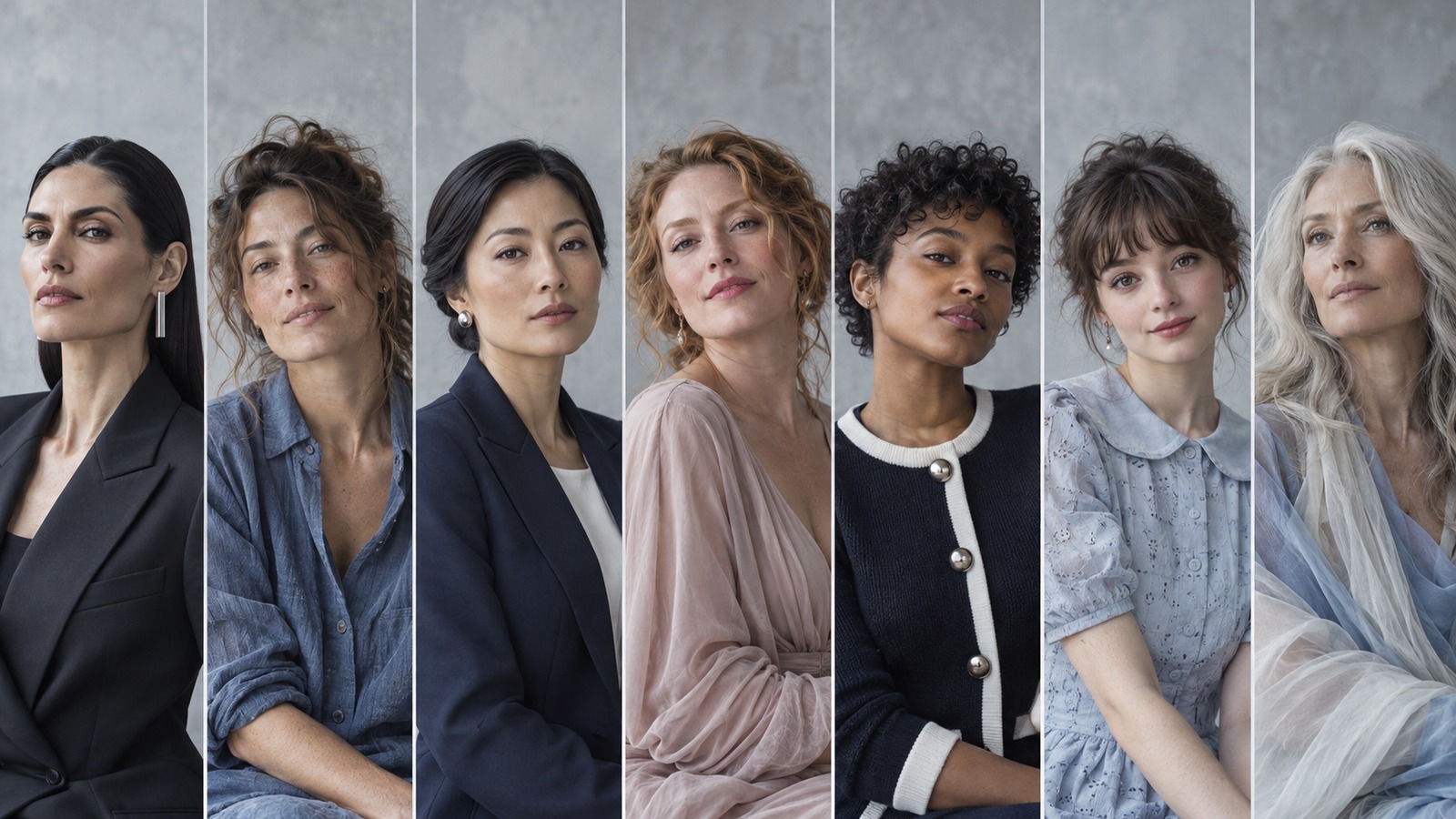
Dramatic
Strong, elongated, angular lines. Try a crisp lapel or a long geometric earring.
Natural
Relaxed, open lines with visible texture. Try a loosely structured shirt or a textured weave.
Classic
Even scale and orderly balance. Try a simple, symmetrical neckline.
Romantic
Rounded, lush shapes and soft drape. Try a curved neckline or fluid gathered fabric.
Gamine
Compact scale and lively contrast. Try a short jacket or a sharply contrasted detail.
Ingenue
Small, delicate, rounded detail. Try a fine collar or a small-scale print.
Angelic / Ethereal
Long, airy, flowing lines. Try a sheer layer or softly elongated drape.
These are examples to compare, not uniform prescriptions. Dramatic and Angelic may both use length, for instance, but one expresses it through crisp structure and the other through fluidity. Romantic and Ingenue both use curves, yet their typical scale differs. Kitchener identifies Angelic as the Ethereal essence; both names appear in style discussions.
Why You Have a Blend, Not Just One Type
An essence blend combines visual qualities rather than forcing every feature into one archetype. You might like a Classic base with a Romantic neckline and a small Gamine accent. Another person may prefer Natural texture with a long Angelic layer. Two or three noticeable influences can be a useful starting point, but they are not a ceiling: Kitchener explicitly says a person can have four or more, even all seven.
Try comparing complete looks under similar light. Keep the color and general fit steady while changing one design choice at a time: a sharp versus rounded neckline, a quiet versus high-contrast print, or a smooth versus textured fabric. Notice which combination feels coherent to you, then keep the elements you enjoy. There is no reliable percentage to calculate from a single selfie or a short online quiz, and a label need not come before useful styling choices.
Kitchener’s own description of his approach connects bone structure with necklines, prints, textures, and accessories. That relationship is the practical meaning of harmony here: repeat or thoughtfully contrast the visual qualities you observe, rather than trying to change your features.
How Essences Complement Body Shape and Kibbe
Use each framework for a different question. A body-shape guide compares bust, waist, hip, and sometimes shoulder proportions to help you consider garment fit and silhouette. Style essences suggest the character of details around the face and throughout an outfit. Kibbe Image Identities explore the overall relationship of clothing lines to a person’s appearance. Shared words such as “Dramatic” or “Natural” do not make the classifications interchangeable.
Start with a garment that fits and has the silhouette you want. Then vary its neckline, fabric, print scale, or jewelry to explore an essence direction. For example, the same straight-leg trousers could work with a crisp angular jacket, a relaxed textured shirt, or a soft flowing layer. If you are comparing proportions for fit, our measurement guide can help. Its measurements do not identify an essence or a Kibbe identity.
You can use these ideas without reaching a final label. Build an outfit around a line or texture you like, assess the whole look in ordinary light, and let your preferences decide what stays.