Body shape guide
Body Shapes: The Complete Guide to Silhouette Types
Body shapes describe the relationship between your bust, waist, hips, and, when you can observe them, shoulders. The familiar names—hourglass, pear, apple, rectangle, and inverted triangle—are shorthand for broad silhouette patterns. They can help you compare garment lines, but they are not a judgment about your body or a rule for what you may wear.
Start with three measurements taken in the same unit, then compare the ratios. A shoulder observation adds information that a bust circumference cannot provide. If you fall near a boundary, use the details that are useful to you rather than forcing a single label. Our measurement calculator offers a descriptive starting point.
The Core Silhouette Archetypes
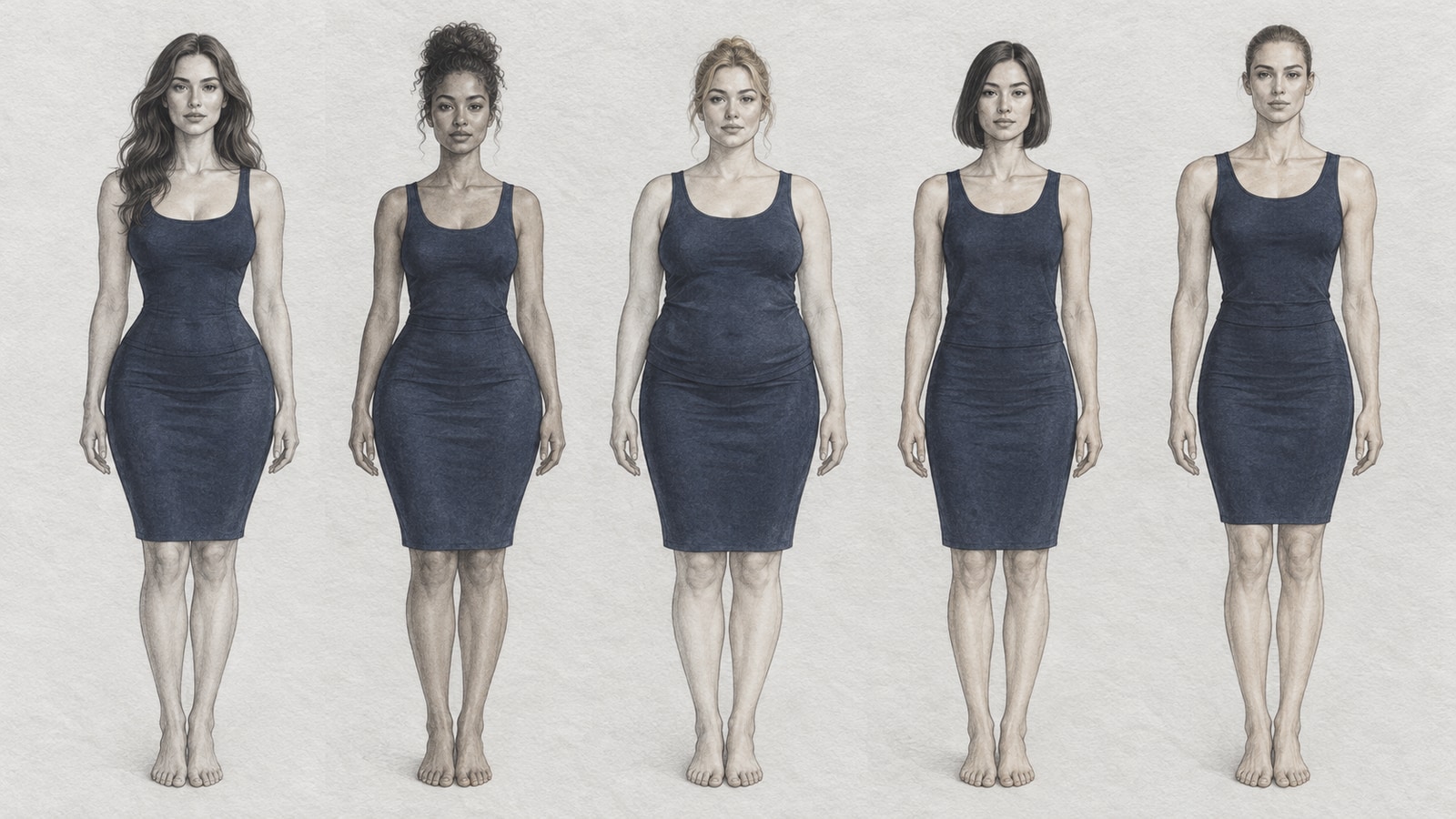
These terms compare relative proportions, not dress sizes. For the simple method used by our calculator, let B be bust circumference, W natural-waist circumference, and H full-hip circumference. Divide measurements in the same unit. For example, B ÷ H compares bust and hip circumference; W ÷ min(B, H) describes waist contrast against the smaller of the two. The cutoffs below belong to this site’s descriptive method, not to a universal fashion or medical standard.
| Pattern | What you may notice | This site’s measurement guide |
|---|---|---|
| Hourglass | Bust and hips are close; the waist is more defined. | 0.95 ≤ B ÷ H ≤ 1.05 and W ÷ min(B, H) ≤ 0.75. |
| Pear | Hips are fuller in circumference than the bust. | B ÷ H < 0.95, unless the waist falls in the apple range. |
| Apple | The waist is close in circumference to the larger of bust and hips. | W ÷ max(B, H) ≥ 0.90. |
| Rectangle | Bust and hips are close, with less waist contrast in this method. | 0.95 ≤ B ÷ H ≤ 1.05 and W ÷ min(B, H) > 0.75, outside the apple range. |
| Inverted triangle | The upper body appears broader than the lower body. | B ÷ H > 1.05 is this calculator’s circumference cue; check shoulder width separately. |
The method labels results mixed near its cutoffs (within 0.01) or when your shoulder observation tells a different story. The order of the checks also matters: the waist-to-larger-measurement comparison is considered first. Treat these numbers as a way to organize observations, not as a precise identification of your frame.
Hourglass
In an hourglass-leaning outline, the upper and lower circumferences are similar and the waist is visibly narrower. A shaped waist seam can echo that contrast; a straight, loose cut creates a different line. Either is a choice, not a requirement.
Pear
In a pear-leaning outline, the full hip circumference exceeds the bust circumference. Compare where a jacket hem ends: one ending above the widest hip point and one extending beyond it create different horizontal lines. Choose by the fit and look you prefer.
Apple
Apple-leaning proportions describe less contrast between the waist and the larger of the bust or hips. A straight garment can skim the middle; an adjustable wrap or tie lets you choose how much waist definition to show. Check the actual garment fit rather than assuming a label predicts it.
Rectangle
A rectangle-leaning outline has relatively similar upper and lower circumferences with a subtler waist indentation. Straight tailoring follows that line; a belt or shaped seam changes the visual focal point. Try both at the same garment length to see which effect you like.
Inverted triangle
An inverted-triangle outline often has visibly broader shoulders than hips. Our B ÷ H cue is only a proxy for upper-to-lower circumference: a bust measurement does not measure shoulder breadth. If shoulder width is central to your question, compare it directly in a mirror or with a garment that fits your shoulders well. Trouser volume and hem width can change the balance of an outfit.
How Proportions and Skeletal Frame Differ
A circumference wraps around the body. Shoulder breadth is a side-to-side observation, so it cannot be calculated from bust, waist, and hip circumferences alone. Bust and hip measurements also reflect more than skeletal frame, including soft tissue and muscle. Two people with similar three-number ratios may look different in the same garment.
For a consistent comparison, measure the bust at its fullest point, the natural waist, and the fullest part of the hips, keeping the tape level and comfortably close. Utah State University Extension’s sewing curriculum distinguishes body and finished-garment measurements and describes measuring around the widest hip point. A garment’s ease and construction add another layer: its outside silhouette is not a direct tracing of the body beneath it.
Clothing can change where the eye lands. A seam, belt, color break, or hem creates an optical focal point; fabric drape and tailoring change the outline. Utah State University Extension’s design principles for clothing and textiles discusses how line, color, and texture direct attention. You can use those effects to explore different silhouettes without trying to “correct” a proportion.
Navigation to Individual Shape Guides
Use the hourglass, pear, apple, rectangle, and inverted triangle sections above as quick guides to each outline. If you are unsure where to begin, measure and compare your proportions with the calculator, then revisit the two closest descriptions. You can also browse the current guides for more on clothing and style systems.
Frequently Asked Questions
Can my body shape change over time?
Yes. If the measurements or visible proportions you are comparing change, a descriptive category can change too. Retake measurements when the old ones no longer help you choose clothes; you do not need to monitor them on a schedule.
Does age determine my body shape?
No age group has one required silhouette. The useful question is how your present proportions relate to the garment you are choosing. Work from current fit and measurements, not an age-based assumption.
What if I match more than one shape?
That is common near category boundaries or when shoulder width and circumference ratios point in different directions. Keep the individual observations—such as a defined waist and broad shoulders—and borrow ideas from more than one section.
Are body-shape labels the same as Kibbe types or style essences?
No. This page compares a small set of proportional silhouettes. Kibbe image identities and style essences are different styling frameworks with their own terms; a measurement ratio does not assign either one.