Style systems guide
Kibbe Body Types: The 10 Image Identities & Yin/Yang Balance
Kibbe body types are more accurately called Image Identities: David Kibbe’s style framework describes how softness and curve (yin) interact with length, angularity and structure (yang) in an overall appearance. The current framework has ten identities in five families. It offers a way to notice and echo your natural lines in clothing, rather than a score for your body or a rule that every outfit must follow.
Kibbe introduced the Image Identity system in his 1987 book David Kibbe’s Metamorphosis and later updated it in David Kibbe’s Power of Style. This overview explains the families, then gives you a practical way to explore them. If you want a guide to measurement-based body shapes, start with our body-shapes overview; that is a separate framework.
The Philosophy Behind Yin and Yang in Physical Appearance
In Kibbe’s styling language, yin describes softness, roundness and curve; yang describes sharper or more elongated lines. These are visual design terms, not judgments about femininity, health or worth. Most Image Identities combine qualities rather than sitting at either extreme. The point is to observe the whole impression of your silhouette and choose clothing lines that relate to it. Kibbe’s current book description emphasizes individuality and explicitly rejects treating natural characteristics as flaws.
Consider a vertical line: the eye can follow an uninterrupted length through a person’s outline or an outfit. A long coat, continuous color or unbroken hemline might repeat that effect. A shorter, more contrasted arrangement creates a different rhythm. Neither is inherently better; the useful question is which relationship between garment and person you enjoy. Curves, width, balance and contrast also influence the whole picture. A single measurement, face feature or garment cannot establish an identity.
Kibbe is distinct from a bust-waist-hip shape label. Our guide to measuring body proportions can help with garment fit, but its tape measurements cannot determine a Kibbe Image Identity. The framework looks at the overall visual relationship among line, bone structure and softer contours, alongside personal style.
The 5 Families and 10 Current Image Identities
The five families are Dramatic, Natural, Classic, Gamine and Romantic. They are a way to organize related line qualities, not five steps on a precise numeric scale. The chart below is a conceptual map: Romantic emphasizes rounded yin, Dramatic emphasizes sharp yang, Classic centers balance, while Gamine mixes contrast and Natural brings a broader, blunter quality to yang. Its left-to-right placement is for orientation, not a test or ranking.
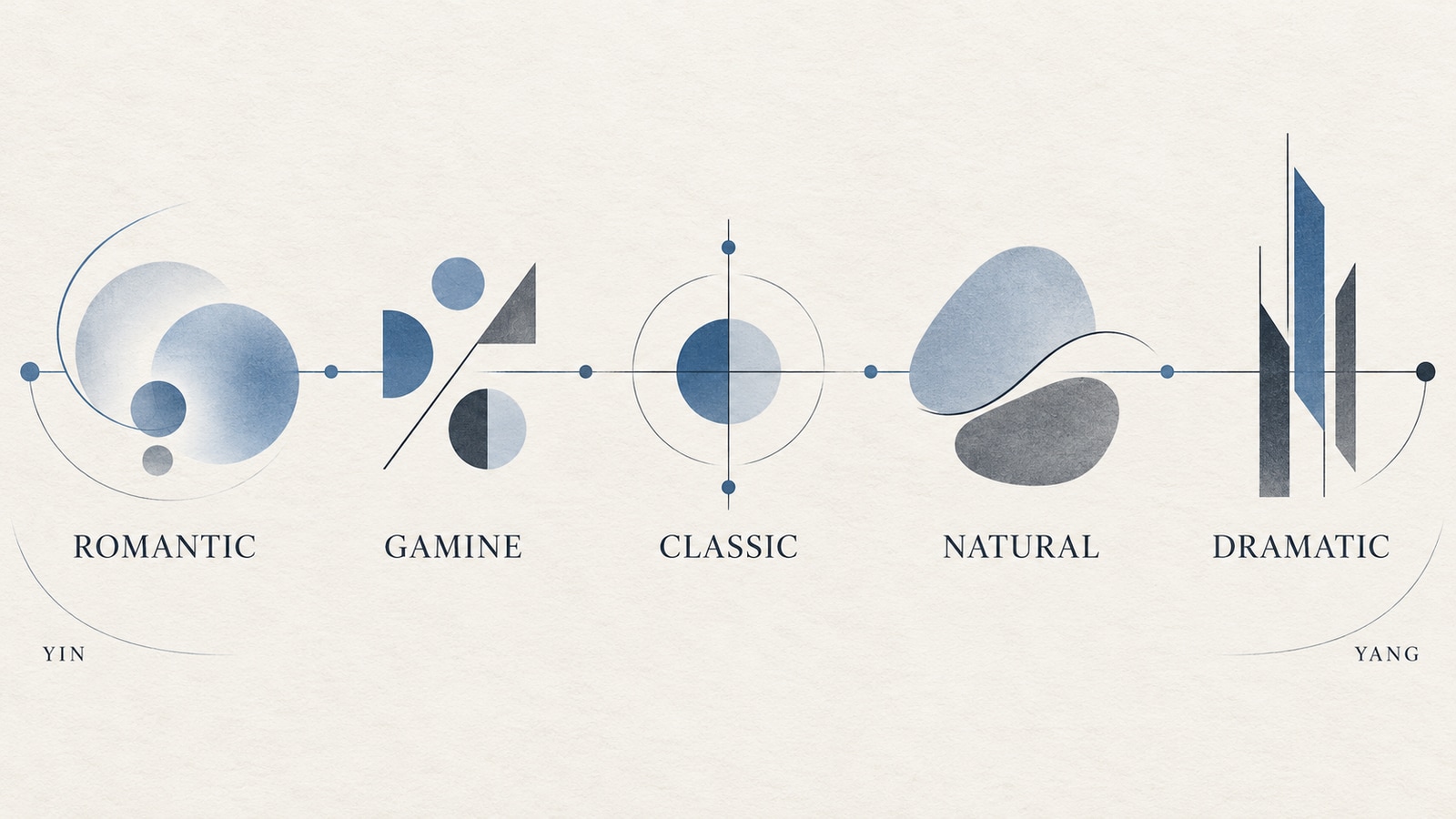
| Family | Current Image Identities | Line idea to explore |
|---|---|---|
| Dramatic | Dramatic; Soft Dramatic | A long, strong line, with added softness in Soft Dramatic. |
| Natural | Flamboyant Natural; Soft Natural | A more open, blunt line; the two identities differ in the balance of length and softness. |
| Classic | Dramatic Classic; Soft Classic | Overall balance with a slight sharper or softer influence. |
| Gamine | Flamboyant Gamine; Soft Gamine | A lively mix of contrasting short lines, with a sharper or softer emphasis. |
| Romantic | Theatrical Romantic; Romantic | Curved lines, with a sharper accent in Theatrical Romantic. |
The ten names above are the current set described by Kibbe’s own site as ten archetypes. The 1987 book used thirteen identities, including pure Natural, Classic and Gamine. That is why older charts and quizzes may show a different total. The families remain useful as an overview, but a family’s two identities are not interchangeable. Nor does “soft” mean a particular weight: it describes a quality of line within this style vocabulary.
The chart and table are starting points, not illustrated body templates. Different people can share an Image Identity without having the same measurements, size, age or wardrobe. The distinction becomes more useful when you compare how actual clothing hangs and moves on you, instead of trying to match yourself to a single drawing.
How to Find Your Kibbe ID and Next Steps
Begin with your overall line in ordinary clothes: do you notice continuous length, a more open shoulder-to-torso line, quiet balance, a compact mix of contrasts or a visibly rounded flow? Then compare complete outfits rather than isolated features. For example, try a longer uninterrupted silhouette beside one with more separation, or a structured fabric beside a softer drape. Notice the effect in a full-length view and in movement. Keep the pieces you like even if an online label suggests otherwise.
If two identities seem plausible, look at how their family qualities differ before narrowing down. A photo angle, a waist-to-hip ratio or a checklist of facial features is too limited to settle the question. Kibbe’s updated Power of Style is the direct source for exploring his current method; it uses guided exercises rather than our site’s measurement calculator. Our body-shape calculator compares measurements for a separate descriptive shape result and does not return a Kibbe ID.
You can use the framework without making a final classification. Treat yin, yang, vertical and curve as clothing-design observations: compare a few silhouettes, see what feels coherent to you, and let your own taste decide.