Body shape guide
Hourglass Body Shape: Proportions, Traits & Styling Guide
An hourglass body shape describes an outline with similar upper and lower proportions and a clearly defined waist. In a three-measurement comparison, the bust and full hips are close in circumference while the natural waist is smaller than both. Shoulder width can add useful visual context, but a bust measurement cannot tell you how wide your shoulders are. These are descriptive proportions, not a standard you have to meet.
If you want to compare your own measurements, start with the step-by-step measuring guide. For a wider comparison of silhouette names, see the body-shapes guide.
Defining Proportions & Measurement Benchmarks
Record your bust (B) at its fullest point, natural waist (W), and full hips (H) at their fullest point, using the same unit. Keep the tape level and comfortably close. New Mexico State University Extension’s pattern-fitting guide explains these measurement points and why garment measurements need allowance for ease.
In this site’s descriptive calculator, B ÷ H from 0.95 to 1.05 indicates similar upper and lower circumferences. If W ÷ the smaller of B and H is 0.75 or less, the result can be hourglass-leaning. A waist at least 0.90 times the larger of B and H is checked first, and results within 0.01 of a relevant cutoff are marked mixed. These cutoffs describe this calculator’s method; they are not universal definitions of an hourglass figure.
For example, B = 40 inches, W = 29 inches, and H = 40 inches gives B ÷ H = 1.00 and W ÷ min(B, H) = 0.725. The waist is less than three-quarters of either outer measurement, so this example falls in the hourglass range of this method. By contrast, if the full hips are appreciably greater than the bust, the same method may suggest pear-leaning proportions even when the waist is defined. Look at the ratios and at how clothes fit rather than treating one label as a verdict.
Best Clothing Silhouettes & Styling Heuristics
If you enjoy showing the natural waist, try a wrap dress, a shaped waist seam, or tailoring that narrows at the waist and allows room at the bust and hips. A V neckline changes the line around the upper body; it does not determine your body shape. Mid-rise and high-rise trousers place the waistband at different heights, so compare both with the top you actually plan to wear.
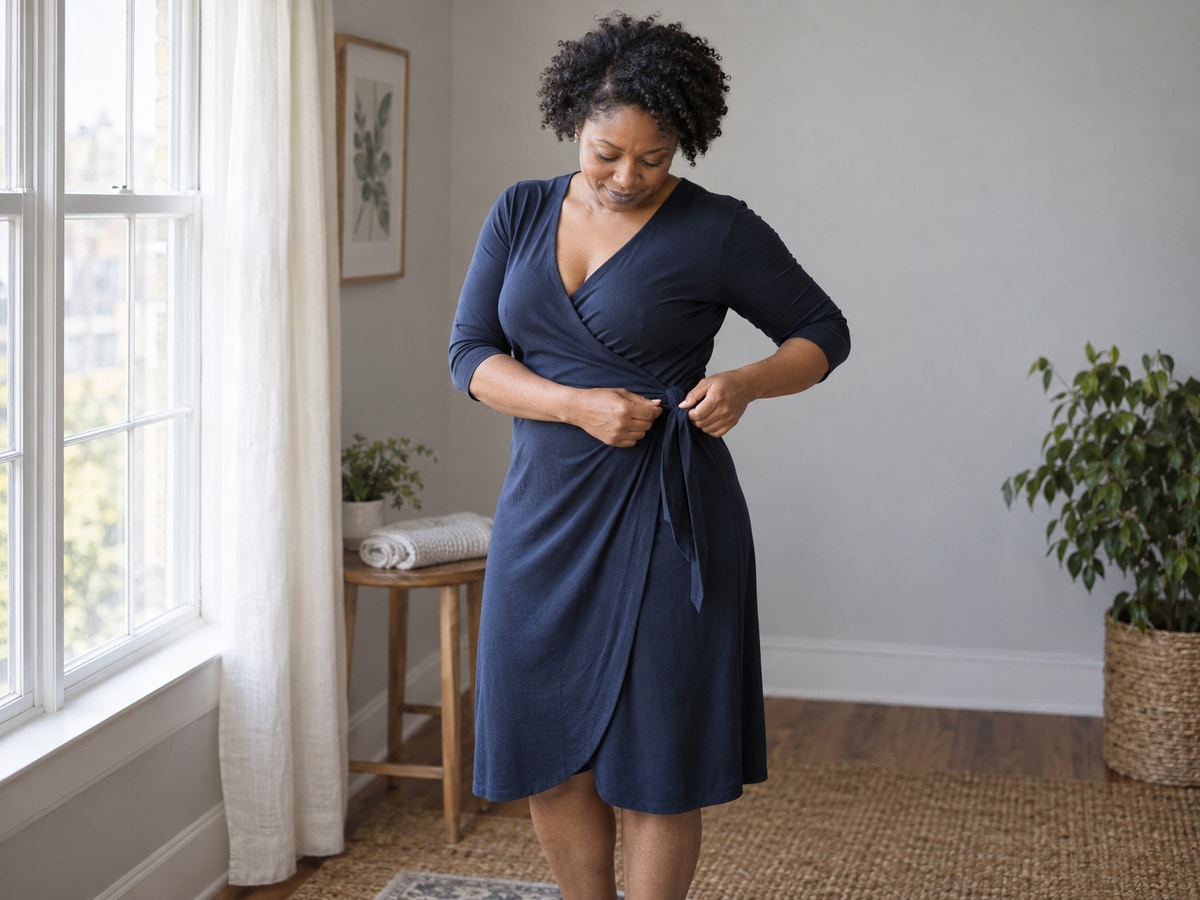
The useful detail in a wrap dress is its adjustable tie and overlapping front: you can change where the waist sits and how much ease the garment has. A structured dress with darts or a defined waist seam offers another way to follow the body’s outline. A softer fabric falls differently from a firm woven one, so check the actual drape while standing and sitting. Utah State University Extension’s clothing-design guide explains how line, color, and texture can draw attention to a chosen area; its design-elements guide distinguishes structural lines from decorative ones.
These are styling options, not rules. A straight dress, relaxed blazer, or low-rise trouser can create a deliberately different silhouette. Choose the line you like and check whether the garment gives you comfortable movement. New Mexico State University Extension’s pattern-alteration guide notes that ease varies with fabric, fit, and style preferences.
Common Styling Mistakes to Avoid
If your aim is to keep the waist visible, an oversized, unshaped layer may cover the contrast between waist and hips. Try leaving a jacket open, choosing a shaped seam, or adding a belt at a comfortable position. If you prefer a straight outline, the same loose layer may be exactly right; it is only a mismatch when it hides a detail you wanted to show.
A very rigid fabric can hold a boxier shape than you expect, while a fabric with more drape may follow the garment’s intended lines. Do not judge either from the hanger alone. Compare the side seams, waist placement, and ease in a mirror, then sit and move before deciding. A size label or body-shape name cannot substitute for that fit check.